


- From Wed 29 July to Sun 2 August
URBAN KALEIDOSCOPE
From 18:00
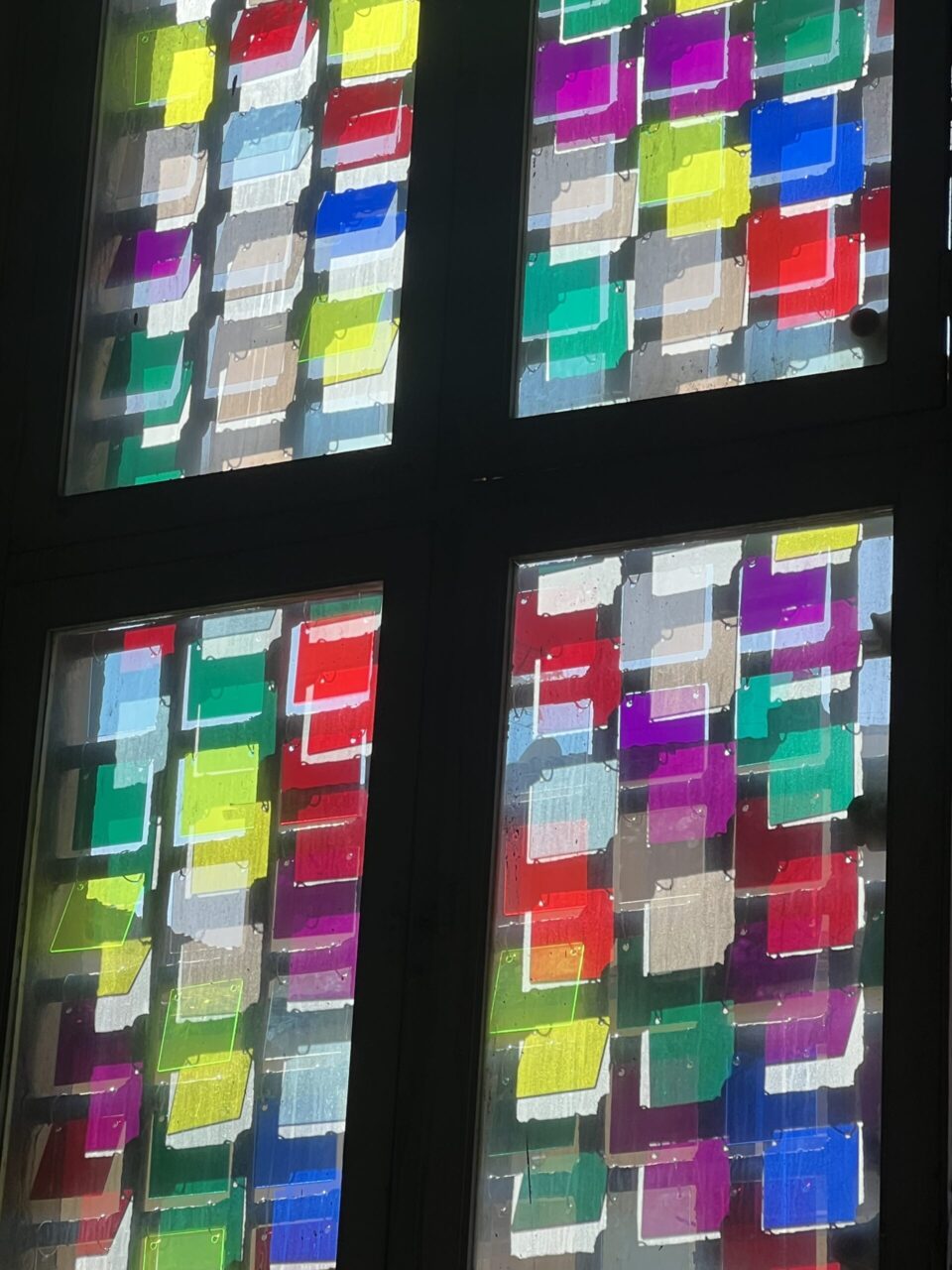
The work transforms the facade of the Pawn Shops into a large device of light, color, and movement, capable of connecting historical memory, sustainability, and urban regeneration.
The project proposes a reflection on the relationship between architecture, time, and perception, the composition of polychromatic modules recalls the great tradition of geometric abstraction of the Twentieth Century, from Piet Mondrian to Ellsworth Kelly, but at the same time reinterprets in a contemporary key the language of ancient Gothic and medieval stained glass. Just as in cathedrals light passed through color to transform space into a spiritual experience, so “Urban Kaleidoscope” returns this dimension to the city in a secular, public, and contemporary form.
The facade is no longer a simple architectural boundary, but becomes a permeable membrane capable of narrating the past and imagining the future, in fact, the work uses light as a design material, it is not the object that constitutes the heart of the intervention, but the phenomenon that it generates.
Every day the sun passes through the colored modules creating reflections, transparencies, and projections that continuously transform the building, making light a true temporal bridge between the historical memory of the masonry structure and the contemporary regeneration of the city.
The palace thus becomes a large urban projector, the colors do not remain confined to the facade, but spread out into the surrounding space, coloring the street, the nearby buildings, and reflecting on the surface of the canal.
Architecture ceases to be a static element and takes on an active role, capable of communicating with the context and involving citizens and visitors in an immersive experience that changes with the hours of the day and the seasons.
Movement is also a fundamental element of the project, the oscillation of the modules, naturally generated by the wind, recalls the rhythm of the waves and the continuous flow of water that characterizes the Livorno landscape. This vibration creates a visual relationship between the solidity of the building and the dynamism of the canal, making the palace appear as a living organism that breathes together with the city; the dialogue between light, color, water, and air constructs a sensory experience in which architecture and environment become a single narrative.
Alongside the aesthetic research, “Urban Kaleidoscope” proposes a precise vision of sustainability, privileging the use of natural light and the action of the wind as generators of the visual and dynamic experience of the work, minimizing the use of technological systems and energy consumption. The intervention is designed to interact with the natural cycles of the day and the seasons, demonstrating how it is possible to create a work of strong impact through an environmentally and urban context-friendly approach.
The jury’s choice rewards a project that fully interprets the objectives of the VISIONI call, proposing an intervention capable of combining artistic quality, innovation, and attention to historical heritage: “Urban Kaleidoscope” does not merely decorate a building, but redefines its role in public space, transforming it into a device capable of producing relationships, emotions, and new ways of living in the city with an intervention destined to become a new recognizable landmark in the city landscape, capable of narrating its memory and, at the same time, projecting it towards the future.
Subscribe to the newsletter to stay updated
Don't miss any news about events in Livorno and surroundings.